


- Koguryo and Balhae
- Anak Tomb No. 3
Koguryo and Balhae


| Title | Southern Wall of the Western Auxiliary Chamber - Portrait of the Deceased - maid1 | ||
|---|---|---|---|
Southern Wall of the Western Auxiliary Chamber - Portrait of the Deceased - maid1
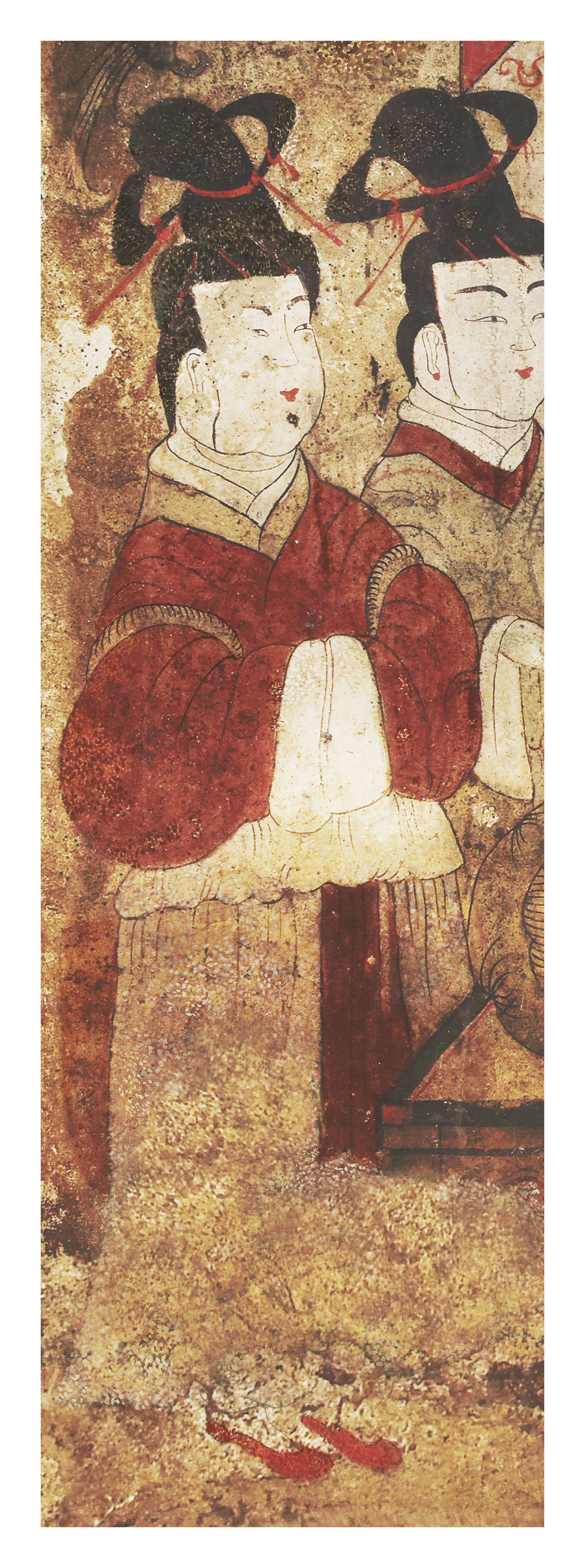
This is a detailed view of the left-most maid depicted on the southern wall of the western auxiliary chamber in Anak Tomb No. 3. The maid's hands are held together under her sleeves in a display of respect. Perhaps she was a maid who would have been a close confidant of the noblewoman. Her hair is looped and raised much like the noblewoman. However, her hairstyle does not feature any free-flowing locks of hair, and the red hairpins securing her topknot appear to be relatively plain in contrast to the noblewoman. Red hair straps can be seen tied throughout the hair, securing the topknot and the semicircular loops. This image can be considered an important clue revealing that this type of crescent moon hairstyle was in fact not a wig.
This type of hairstyle was popular with Koguryo era women from the Pyongyang region regardless of social status. Evidently, all women of the time were equals when beauty was concerned.
The artwork is an excellent example of realism from the Koguryo era. The maid is wearing a red Jeogori (traditional Korean upper garment) and a white inner-Jeogori. She is also wearing a white skirt, and the folds in the waistline indicate that the fabric may be sheer. A variety of different fabrics appear to have been used near the waistline. She can be seen wearing red shoes below the white skirt. Although the maid's attire isn't nearly as extravagant as the noblewoman, her Jeogori is relatively fancy, indicating that her status is higher than the other maids in the portrait. Similar to the noblewoman, this maid's overall appearance is voluptuous and solemn. Similar to the nobleman's portrait of the deceased, the facial features of the figures do not convey a sense of individual personality. This is a common characteristic of ancient paintings.